



Insights
Boardwave Live 2026: Five key takeaways
The next chapter isn't about whether Europe can build. It's about how far we can go.
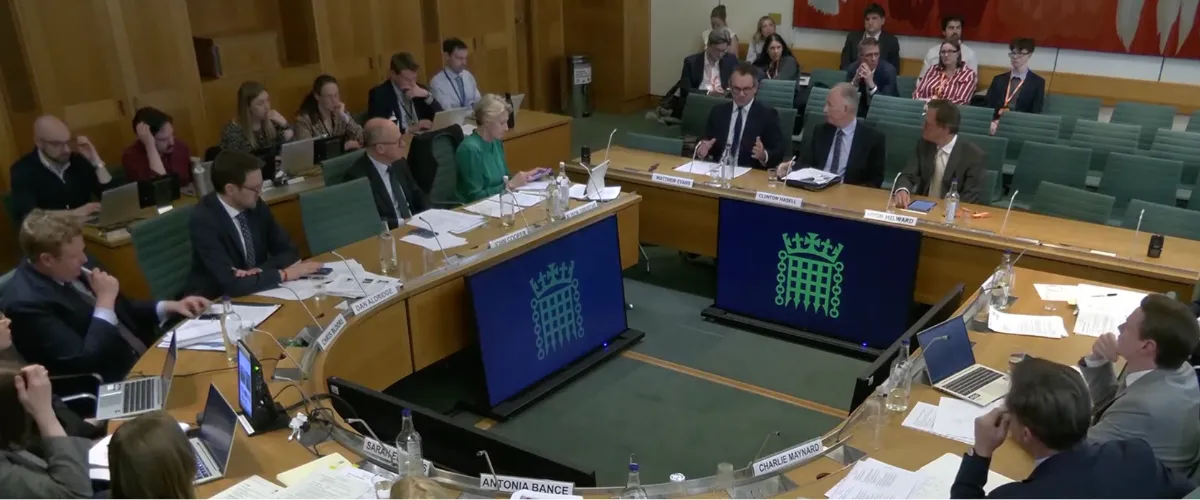
Energy costs, grid delays and infrastructure uncertainty are emerging as serious tests of UK competitiveness. Parliament's AI inquiry heard the evidence.
On 14 April 2026, the Business and Trade Select Committee heard evidence from Hugh Milward, UK Vice President of Corporate Affairs at Microsoft, Clinton Hasell, Chief Business Officer at Kao Data, and Matthew Evans, Chief Operating Officer & Director of Markets at techUK, as part of its inquiry into Artificial Intelligence, Business and the Future of the Workforce.
Their panel forced attention onto the harder question underneath the usual AI debate: how the UK expects to compete if it cannot reliably power, house and scale the infrastructure AI depends on. Power, compute, data centres, grid access and industrial energy costs may not generate the flashiest headlines, but they are quickly becoming some of the most decisive variables in the UK's AI future.
Milward told MPs that Microsoft currently offers around 10,000 AI services to customers, but only about 1,500 are physically based in the UK. Britain already uses AI at scale, but a much smaller share of the underlying infrastructure sits domestically. Closing that gap depends on getting the basics right.

Policy conversations now reach quickly for phrases like "sovereign capability", "AI leadership" and "strategic infrastructure". They sound reassuring, but they blur important distinctions. Training frontier models requires one kind of environment. Running inference workloads requires another. Supporting enterprise AI tools, hosting sensitive data domestically or enabling distributed processing raises a different set of needs again.
Does sovereignty mean model training on UK soil? Domestic inference? Secure processing for critical sectors? The panel made clear those questions cannot be bundled together and the distinction matters directly to businesses in regulated industries. For companies handling sensitive financial, health or government data, data residency is already a live compliance question. Whether the UK can offer domestic processing capacity at commercial terms will shape where workloads go and how exposed organisations are if geopolitical conditions shift.
The evidence pointed clearly to industrial electricity costs as a major drag. For operators and investors making long-term decisions, those costs directly affect whether the UK looks compelling against markets where running large facilities is materially cheaper.
The figures cited were stark. Hasell told MPs that a 100MW data centre could face annual running costs of roughly £220m in the UK, compared with £156m in France, £67m in Sweden and £55m in the US. That is the kind of cost gap that changes boardroom decisions - and by the end of the session, energy costs felt firmly established as a national competitiveness issue rather than a niche sector complaint.
For major developments, everything turns on whether power capacity can be delivered with certainty and on a timeline solid enough to unlock hundreds of millions of pounds of investment. Long waits are difficult enough. Moving dates and patchy visibility undermine the confidence required to commit capital at scale.
Hasell described one development site in Harlow serving the Cambridge corridor that had been quoted a grid connection date of 2037. In AI terms, that feels less like a delay than an entirely different era. He also referred to other sites where dates had repeatedly slipped, creating serious commercial uncertainty around developments already backed by large capital commitments.
The UK may have the land, the capital and the market interest, yet still struggle to convert those ingredients into live infrastructure at the pace needed.
Data centres are often treated as a support layer beneath the real action. In practice, they now sit close to the core of the AI growth story: more politically visible, more economically significant and more central to questions of national competitiveness than the public debate usually reflects.
The financial scale helps explain why. A 36MW data centre can cost around £500m to build, before accounting for the IT infrastructure inside. These are long-horizon, capital-intensive investments that depend on confidence in energy, land, planning and grid delivery. Some future demand may shift towards more distributed processing and edge capacity, but without a stronger answer on cost, certainty and capacity, attracting sustained investment will remain harder than ministers would like.
These infrastructure constraints are already shaping commercial decisions for tech and AI companies operating at scale.

On cost: as compute demand rises, where that compute is physically located and under what energy pricing it runs will increasingly affect the unit economics of AI-dependent products. Companies that rely on third-party cloud infrastructure may have limited direct exposure today, but the pricing environment for those services is sensitive to the same dynamics.
On regulation: for businesses in financial services, healthcare or defence supply chains, the sovereignty question has direct operational relevance. Data residency requirements are tightening, and the UK's ability to offer credible domestic capacity at competitive terms will influence how organisations structure their data architectures and manage regulatory risk.
On due diligence: grid timelines and energy costs deserve serious scrutiny alongside the more obvious factors in any significant infrastructure commitment. The gap between UK and European energy costs is wide enough to affect long-term business cases in ways that are not always visible at the outset.
The UK's AI ambitions depend on execution at the infrastructure level. The policy intent is clear. Closing the gap between intent and delivery is what will determine whether those ambitions are realised.
This article draws on oral evidence given to the Business and Trade Select Committee on 14 April 2026 as part of its inquiry into Artificial Intelligence, Business and the Future of the Workforce.
_(logo).svg)















.webp)











.webp)


























.svg)




.svg)
















.webp)






.webp)
%20(1)%20(1).webp)