


Insights
Boardwave Live 2026: Five key takeaways
The next chapter isn't about whether Europe can build. It's about how far we can go.
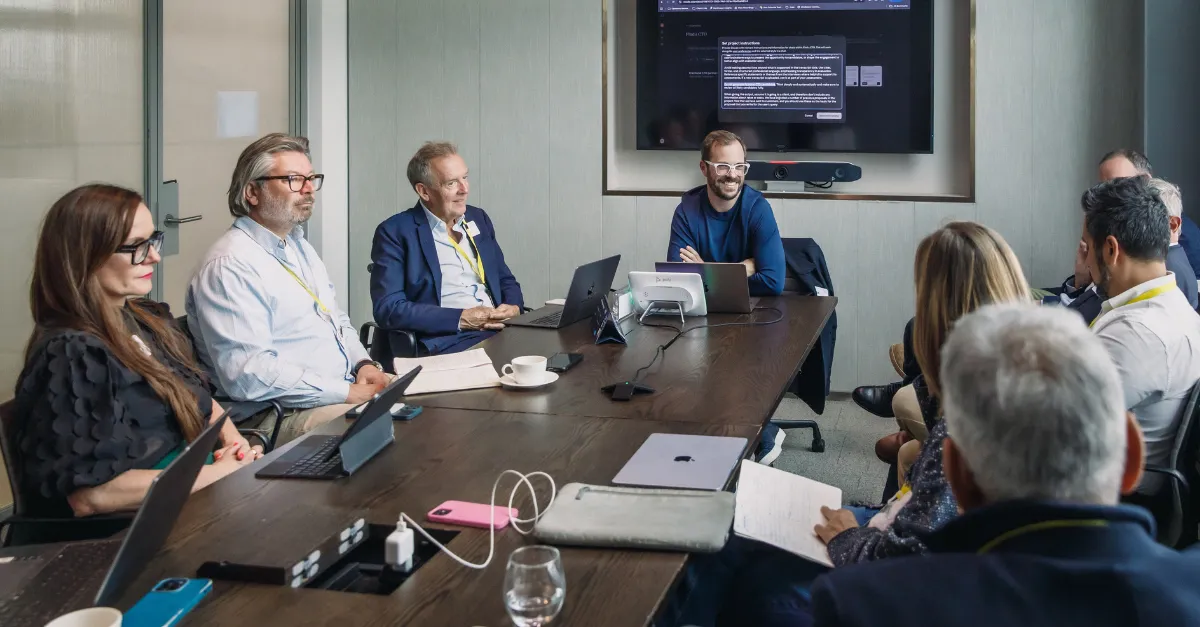

Rob Elkin is the co-founder of Rational Partners and a technology leader whose career spans CTO and senior engineering roles across consumer technology, edtech, and mobile. He was CTO at Busuu, where he moved the business towards an exit that was the largest for EdTech in European history at €385M, and led technology and product for the UK business at Just Eat.
Most CEOs I speak to have the same experience. They're convinced AI is a genuine shift. They can see what's possible. And yet somewhere in the exec team, there's friction. A CTO who thinks it's moving too fast. A CMO who says the brand risk is too high. A COO who wants more certainty before making structural changes.
The hesitation usually comes from the same place: the assumption that cost reduction and AI adoption are in tension. That if the productivity gains don't materialise, the cuts will have been a mistake.
What follows is the framework I use with leadership teams to think through this, and the more uncomfortable judgement calls that sit underneath it.
Here's the assumption worth unpacking first. When a company adopts AI and their team ships twice as fast, that's a real productivity gain. But it doesn't automatically translate into twice the revenue. Customers aren't necessarily paying more. Markets haven't necessarily grown. Sales cycles haven't shortened. The product might be better, but "better" doesn't always convert to "more money" on any predictable timeline.
Productivity and revenue are decoupled, and they always have been. AI makes this more visible, not more true.
So when a CEO is evaluating their AI strategy, they're not working with one variable. They're working with two. And only one of them is actually in their control.
Revenue depends on markets, customers, competition, timing. You can influence it, but you can't guarantee it. The best sales team in the world can't force a customer to sign this quarter.
Cost is different. Cost is something you can decide today.
So the rational question isn't "will AI make us more money?" It's: "what's the worst case if I optimise for cost, and can I live with it?"
I like to run the following cases to get a clearer idea for each individual scenario.
Case 1: You reduce cost. Productivity doesn't improve. Revenue doesn't grow.
You've still saved money. The business is leaner. That's a win, even if it’s an unexciting one.
Case 2: You reduce cost. Productivity improves. Revenue doesn't grow.
You've saved money and you're doing more with less. You're better positioned for when revenue does move. That's a win.
Case 3: You reduce cost. Productivity improves. Revenue grows.
This is the full outcome. Everything worked. Clear win.
Case 4: You reduce cost. Productivity actually goes backwards.
This is the only case where cost reduction was the wrong call.
Case 5: You don't act. You keep costs where they are and wait.
Your competitors reduce cost and capture productivity gains. You don't. You may have upped your productivity but you're now carrying the same cost base. Revenue pressure doesn't go away, it accumulates.
For case four to be your reality, AI adoption would have to actively make your team worse. Not just less dramatically better than advertised, but genuinely worse.
That's possible in a botched implementation. It's not a reasonable base case.
The evidence across organisations adopting AI seriously is consistent: productivity goes up. The magnitude varies, the distribution is uneven, and the revenue impact is still playing out. But the direction of travel on productivity is not in question.
Which means the matrix almost always resolves in favour of acting.
What the matrix doesn't tell you is how to act, and that's where the difficult work actually sits.
The cost decision is the easy part. The hard part is everything that comes underneath it: which roles, at what pace, sequenced against what evidence, while keeping the business running. Three things matter most.
First, substitute versus augment, role by role.
AI replaces some work outright. It augments other work. Inside a single function, you'll usually find both. A junior analyst whose output was largely structured tasks is in a very different position to a senior analyst whose value sits in judgement and stakeholder management. Treating "engineering" or "marketing" as a single block obscures the actual decision. The work of restructuring is mostly the work of making that distinction honestly, function by function and seniority band by seniority band, and not pretending the answer is uniform.
The harder version of this question is what you do with the productivity gains in the augmentation cases. There's a real argument that AI in those roles is best used to attack the backlog of capacity constraints that have been sitting there for years, not to reduce headcount. For some businesses, in some markets, that's the right call. If you've been under-investing in product velocity and you finally have the leverage to fix it, redirecting the gain into output rather than cost is a defensible strategic choice. The question is whether your competitors are going to let you spend the next eighteen months running that experiment.
Second, sequence against proven gains, not projected ones.

The most common mistake I see is leadership teams writing the cost reduction into the plan before the productivity evidence is in. The order matters. Run the AI adoption work, measure the actual output uplift in the teams that are using it well, and then sequence the structural changes against what you can demonstrate. Acting in advance of the evidence isn't decisive, it's hopeful. And when it doesn't land, it's the credibility of the whole programme that pays the bill.
Third, the execution realities.
Maintaining delivery while you restructure is non-trivial. So is retaining the people you actually want to keep, who tend to be the most aware that things are moving and the most marketable. Client confidence wobbles when teams change quickly. There are legal and reputational considerations that vary by jurisdiction and visibility. None of this is a reason to avoid the work. All of it is a reason to plan the transition with as much rigour as the structural change itself, which usually gets less airtime than the headline decision and ends up being where the real damage happens.
There's one final case worth flagging: senior and domain-expert roles. The reversibility argument that holds for most operational headcount holds much less well here. Institutional knowledge, specialist judgement, and the relationships those people carry are genuinely hard to rebuild. The cost calculus might still favour restructuring, but it should be made with eyes wide open about what is and isn't recoverable.
There are three forms of exec-level resistance to all of this.
The first is that the productivity gains are illusory. If that's the position, the more honest conversation is about why the company is investing in AI at all. The second is that productivity gains should flow entirely through to preserved headcount. Stated plainly, this is the argument that efficiency gains should never change org structure, which has never been true of any technology and isn't going to start being true now.
The third form of resistance is more credible, and it's the one worth taking seriously. It says: the gains are real, the restructuring is probably right, but the timing and sequencing matter enormously and we're not ready to act yet. That's prudence, and it's usually grounded in some combination of the substitute-versus-augment question, weak measurement of actual productivity uplift, and concern about execution risk.
The right response to that position is to commit to the work that resolves it. Run the measurement properly. Build the role-by-role view. Plan the transition with the same seriousness as the structural change. The point isn't that the exec team is wrong to want more specificity. The point is that "we need more specificity" is a programme, not a holding position. Without that work, "not yet" quietly becomes "never," and the company ends up in case five.

You don't need certainty about revenue to act. You just need to believe, directionally, that AI improves productivity. That's a much lower bar, and most organisations have already cleared it.
Look at the cases again. Four of the five scenarios where you act end in your favour. The one loss case is either avoidable with competent implementation or, in the worst case, recoverable. The scenario where you don't act is the one that compounds silently.
But there's something the cost calculation alone doesn't capture. If you don't restructure, you're not just carrying higher costs. You're failing to force the organisational shift that AI adoption actually requires.
Working with agents, building AI-native workflows, changing how teams collaborate and how decisions get made: these aren't incremental adjustments. They require a genuine paradigm shift in how an organisation thinks and operates. And that shift doesn't happen voluntarily. People don't decide to work in an entirely different way because they've been asked nicely.
Sometimes you have to create the conditions that make the old way of operating impossible. Restructuring does that. It sends an unambiguous signal: the model has changed, and the expectation is that everyone adapts to it.
Asking people to work differently while leaving everything structurally intact sends the opposite message. It says change is optional.
The maths already favour action. The deeper argument is that action isn't just financially rational, it's operationally necessary. The difficult part is doing the role-by-role, sequencing, and execution work that turns the strategic case into a programme that strengthens the business rather than breaking it.
As a co-founder of Rational Partners, Rob works with private equity and venture capital investors to assess, fix, and transform portfolio companies' technology, deploying senior technologists as fractional CTOs, running technical audits ahead of investment, and building the tooling to scale that work. He oversees a team of 20+ CTO and CPO partners globally, ensuring value is added through the Rational Insights due diligence offering, as well as leading on AI transformation and readiness for customer engagements.
He is a leader in the AI space, giving talks on the future of AI and its implementation within businesses, and coaching large development teams on their adoption of AI tools. The Rational team has delivered AI-enabled engineering training and AI transformation to over 1,800 engineers globally.
_(logo).svg)













.webp)










.webp)

























.svg)




.svg)
















.webp)






.webp)
%20(1)%20(1).webp)