CEO, Raspberry Pi
From a kitchen-table charity to the London Stock Exchange, Eben Upton has built Raspberry Pi into a billion-pound business that has sold tens of millions of computers - while rescuing the vanishing generation of programmers it was created for, and doing it with a small team he hires slowly and rarely loses. Here he talks mission, growth, and why happiness and high performance were never a trade-off.
By Amy Wilson Wyles
"If you give kids programmable computer hardware, some of them learn to program. That's really what I was trying to recreate."
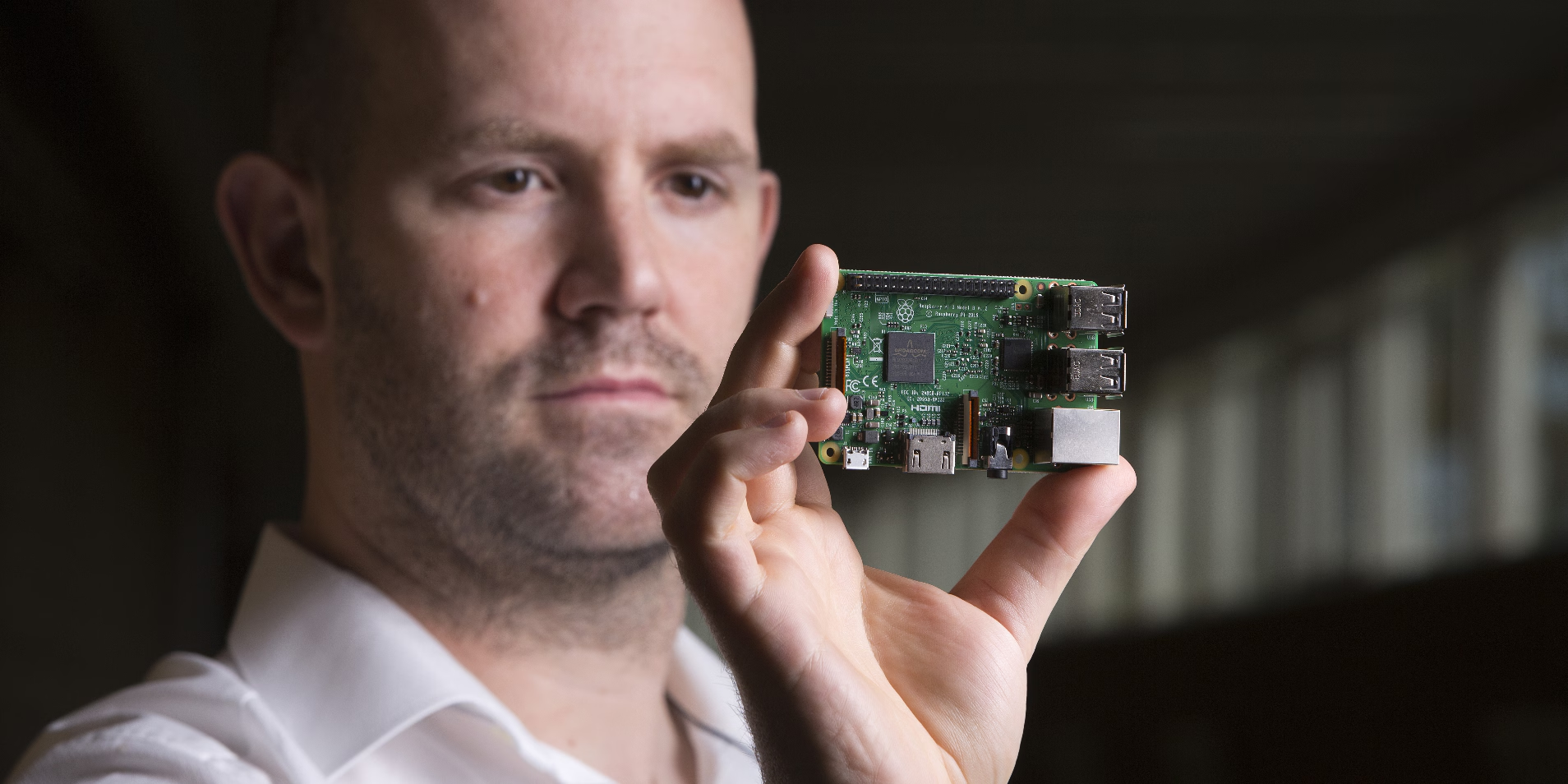
It is, he admits, a very simple story. Give a curious child a machine that invites tinkering, and a certain number of them will be drawn in for life. Eben Upton was one of those children. Decades later, the company he built to instil that same spark of curiosity has sold tens of millions of computers, listed on the London Stock Exchange, and become one of Britain's most successful technology businesses.
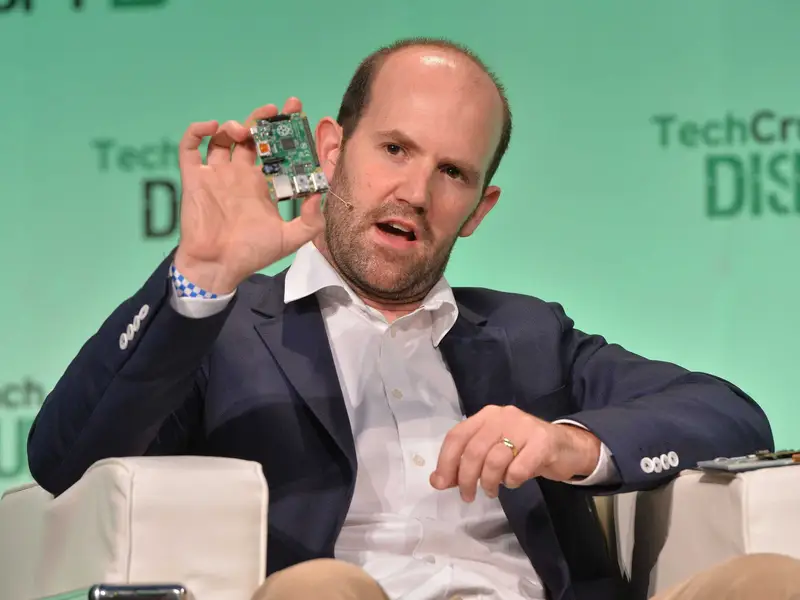
Upton was born in 1978, and came of age in what he calls the tail end of Britain's home-computing boom. He was a Lego kid first - space Lego, mostly - and then a BBC Micro kid, learning to program on the beige boxes that sat in the corner of every 1980s classroom. The trigger was competitive: a friend, eight or nine years old, could already write a bit of code. Upton wanted to keep up. So he learned.
What was unusual, even then, was the second instinct running alongside the engineering one. Growing up just outside Leeds, he would stand in the railway station and watch the commuters stride past with their briefcases, in a hurry, and feel a visceral pull towards that world. "I really wanted that," he says - the sense of being a business person, not just an engineer. He is amused by it now. He doesn't wear a suit. He doesn't carry a briefcase. "But I am in a hurry quite a lot."
Academically, Upton moved fast - fast enough to finish school a year early. Rather than arriving at Cambridge underage, he spent the intervening year working as a junior software engineer at IBM, his first taste of professional engineering and, he says, effectively his freshers' year. He met people there who shaped his career; and one of them even works for him at Raspberry Pi today.
It left him a lifelong believer in the gap year, with one condition. "If you just work in Tesco for half a year, take the money and go travelling for the other half, that's fine, but I think it has less value. If you can find something to do, and experience the real world of work, then I think you take more from it." For most subjects, he argues, a year to take a breath before plunging into university is "extremely valuable."
At Cambridge he read Physics and Engineering, took a first in his second year of physics - and then hit a wall. "Everyone hits their ceiling in maths at some point. I hit mine. I couldn't do quantum, I couldn't do thermodynamics very well, and I just realised ‘yeah, I'm done now.’" He switched to engineering and later on as a post-grad, computer science, on a simple realisation: "What I'm on Earth to do is make things." Deliberately, he had never studied computing formally before. He wanted to keep it as his hobby.
He kept it as rather more than that. At twenty, during his studies, he co-founded a games company, Ideaworks3D (now Marmalade Game Studio), which is still going strong in London some twenty-eight years later. It remains a quiet source of pride. "Not many companies last twenty-eight years," he says, "sitting there employing people, paying tax, paying people's mortgages." Alongside it he ran a couple of what he calls lifestyle businesses - a handful of contractors, a few hundred thousand pounds of turnover, no ambition to grow - the kind of thing that paid for a PhD that overran, and a house, and a wedding.
The idea that became Raspberry Pi grew out of a problem he could see from the front of a lecture theatre. By the 2000s, Upton was helping recruit undergraduates to study computer science at Cambridge - and the applicants were thinning out and arriving less able. The home computers that had turned his generation into programmers had vanished, replaced by sealed appliances that taught nobody anything about building. Cambridge's applications had collapsed from around 600 to 200 for 100 places. "We never let anyone in who was stupid," he says, "but we got to a point where we were letting in every single smart applicant. That's not healthy."
He calls it a trench in the workforce: a missing generation of programmers, so he set out to rebuild the on-ramp. He and a small group of Cambridge colleagues and engineers - including hardware designer Pete Lomas and Upton’s wife Liz, a former journalist who would go on to run communications - incorporated the Raspberry Pi Foundation as a charity in 2008, then spent years working out what to build.
The project might have drifted indefinitely had the BBC's Rory Cellan-Jones not told his readers it was happening. "Suddenly we realised we'd promised a bunch of people, and we weren't anywhere near actually making it happen." Nine intense months later, in February 2012, they had something buildable and sellable. Pre the term “going viral” they did just that - selling over 100,000 units on the first day. It took six months to actually fulfil them.
There was a problem behind the triumph: a charity financed by mortgaging a house and that had scraped together enough money for perhaps 10,000 units could not finance 100,000. So they borrowed a model from chip designer Arm. Rather than manufacturing, they licensed the brand and the technology to distributors - RS and Farnell - who put up the capital and the reach in exchange for a royalty. It is lower-margin but enormously scalable, and it can be run with almost nobody. Raspberry Pi sold roughly 800,000 computers and ran for eighteen months before hiring its first salaried employee.
From there it kept growing: first hobbyists, then educators, then, increasingly, industrial and embedded customers. Today, by unit shipments, Raspberry Pi is essentially an embedded-systems company that happens to retain a vibrant hobbyist following. The charity it spun out of, now led by chief executive Philip Colligan, funds a huge amount of teacher training and school curriculum work. "We built a billion-pound foundation from my kitchen table," Upton says, still sounding faintly astonished. "We're much better at teaching computer science now than we ever were in the 1980s."
He is unsentimental about how bad things were and passionate about where they should be. For years, he points out, the computing taught in schools was really secretarial training: how to use Word, and how to use Excel if you were lucky. "We managed to make screwing around with computers the most boring subject in school. That takes real commitment."
The hobbyist route had one significant flaw: it was overwhelmingly male, as computing-as-a-hobby has always tended to be, adjacent as it is to gaming. Upton's own engineering cohort at Cambridge had been more than 80% men. What proper, universal provision does, he argues, is give everyone a fair crack. The Foundation's Code Club programme for nine-to-thirteen year olds now runs at around 42% girls, a figure that he’s proud to say is consistent and increasing.
He is fascinated by how culturally contingent the imbalance is. Programming was once seen as menial, clerical, female work; then it became a prestige role for scientists, and only then did it become male dominated. In Italy, he notes, advanced mathematics and computing are far more gender-balanced than in Britain. He remembers taking an early Raspberry Pi into a Cambridge school and watching the girls elbow the boys out of the way to get at the keyboard.
The pipeline, though, is leaky, and the leaks are multiplicative - at GCSE, at A-level, at university, at the first job, and again on return from parental leave. "Work on any one of them and you make things better. But you have to work on all of them to fully solve the problem."
Which is the thinking behind a parental-leave policy the company recently introduced - after a long search for the right intervention. It is paid as a £1000-a-month gross sum to any employee with a pre-school aged child, with no administrative burden of measuring and refunding spend, which makes it progressive: worth proportionally more to lower-paid staff. It helps female employees, and equally the female partners of male employees. "I've got people here for whom it's a twenty-four-grand-a-year pay rise. That makes a huge difference." His view is blunt: a big company that isn't doing something like this "has a defect in its thinking about the world."
One of the most telling stats of Raspberry Pi is their staff retention rate, which sits at just under 100%. Ask him how he hires the right people and keeps them, and the answer is one word. "Slowly."
He genuinely cannot understand the churn elsewhere in tech, where people seem to change roles every eighteen months and companies hire handfuls of people every few weeks. "It takes six months to learn where the coffee machine is, time to build relationships, and then you spend your last six months interviewing for the next role. So you really only get six months of actual work per person." When someone leaves, either by choice or otherwise, “you lose a lot of institutional knowledge when they walk out of the door”. Recruiting, for him, is therefore a deliberate, rate-limiting step. Senior hires often come through people he already knows, or via temp-to-perm trials. Junior hires come through internships that start in a student's first year and run across two or three summers, with a no-strings monthly bursary during termtime. The only strings are informal: don't take the money if you know you’re heading for a bank, and if you do interview, give us first look.
The cultural test is simpler still. "Don't hire that one guy - the one who makes your heart sink on your way to work. And if you accidentally hire them, fire them." Beyond that, the formula is simple: pay well, if not at American rates; create a nurturing environment; give people agency, self-determination, and the confidence to thrive. He pays market rates rather than “Amazon rates”, and is unbothered by the gap - recounting, with relish, a meeting with a former nuclear-submarine commander who said working for Jeff Bezos was more stressful than driving the submarine.
The result is a company of around 145 people with strikingly little staff turnover. But Upton isn’t keen on being held up as a model. "I'm really reluctant to be a beacon," he says, "because the thing about this place is the absolutely exceptional calibre of the people in the building. Most people out there are not exceptional - and the much more interesting question is how you build an effective organisation out of ordinary people." He says this with obvious affection for his staff, and obvious discomfort at trying to generalise from them.
He is similarly unconvinced by the cult of overwork - the "996" ethos (9am to 9pm, six days a week) lately imported from Silicon Valley and China. "What is that, a seventy-two-hour week? I’m just not convinced it’s healthy and it just isn't borne out when you look at the car parks in Silicon Valley." Visit the car park of a famous American tech employer at ten in the morning, he suggests, and you will find it half empty. The maths works, he concedes, for a single twenty-four-year-old with no partner, no children, and a meaningful slice of equity in something that might be worth a fortune. "But as a general description of how regular people in the tech industry should and do work? No."
When Raspberry Pi listed on the London Stock Exchange in June 2024, it did so against the prevailing wisdom at the time: that ambitious tech companies belonged in New York. Upton is unrepentant, and a little old-fashioned about it: the natural destination for an ambitious company, he believes, is the public market - a point even Anthropic, OpenAI and SpaceX feel the pull of. For a company his size, London is simply lower-friction, with a lighter regulatory load than New York's quarterly reporting and Sarbanes-Oxley. As a respectable mid-cap at home, the company commands attention; as a small foreign listing in the US, he reckons, it would vanish into the noise. "And the American money finds you anyway." Some companies should list in New York, he allows. The idea that you have to is nonsense.
For all that his life's work has been putting computers into children's hands, Upton's view on the technology of the moment is uncompromising. Keep AI away from kids, he says: no phones until eighteen, and he intends to disable the AI tools on his own children’s tablets and eventually their laptops. "It's mental poison. You have to learn to struggle. Your brain atrophies otherwise. We don't let our kids drink or take drugs; we shouldn't let them use these tools."
On what AI means for the next generation's choices, though, he counsels calm. It is far too early, he argues, to give anyone meaningful advice, "there's no data, there's nothing to go on." The answer is the same as it always was: choose subjects that are intellectually rigorous and, where you can stomach it, quantitative. "People imagine the STEM subjects are narrowing, that you end up in a lab coat. In fact they're broadening. They guard your options." His final word on the subject is two of them: "Don't panic."
There is a neat symmetry to Eben Upton's career. He was a child who learned to program because someone handed him a machine that rewarded curiosity; he grew up to manufacture that exact experience, by the million, for children who would otherwise never have had it. Along the way he built a billion-pound business almost as a by-product of an educational mission, and he runs it with a contrarian's calm - hiring slowly, keeping people, ignoring the overwork arms race, listing where it suited rather than where fashion dictated.
He would hate to be called a beacon, and says so. But in a sector renowned for churn, burnout and the relentless pursuit of scale at any cost, a company that grows by patience and treats its people as humans looks, from the outside, an awful lot like a light in the dark.
Most important skill for leaders today? Endurance.
What do you wish you'd learned earlier? How to study! School was too easy, Cambridge too hard.
A book or resource that changed your perspective? Grinding It Out, by Ray Kroc.
What piece of tech could you not live without? Nespresso coffee machine.
What do you do to recharge after a tough day? I run.
One habit that's contributed to your success? Asking dumb questions.
Advice to aspiring entrepreneurs? Surround yourself with smart, decent people. Find out makes them feel fulfilled, and find a way to give them more of that.

_(logo).svg)













.png)










.png)
























.svg)




.svg)
















.webp)