.png)
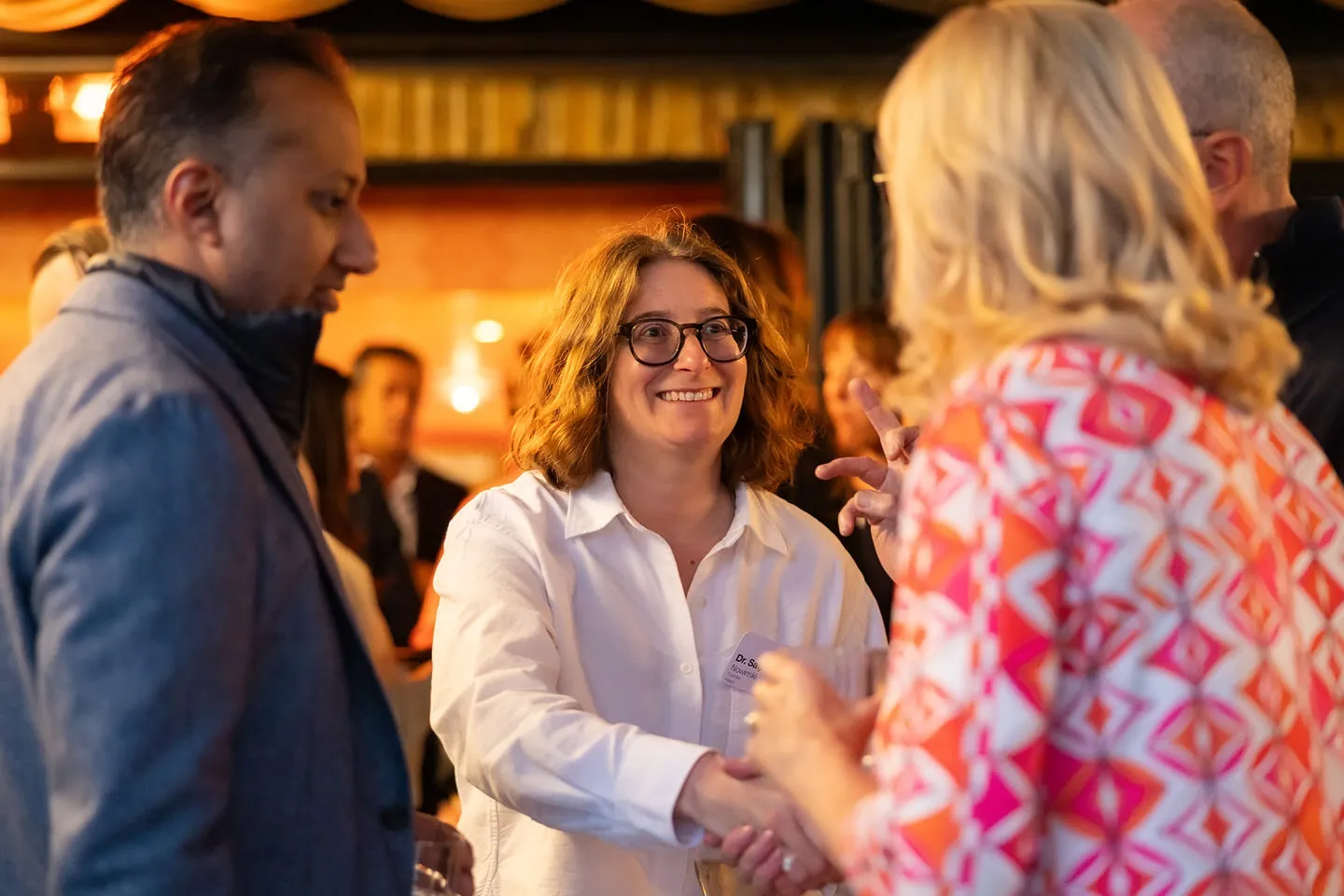
From a tough lumber town in British Columbia to the boards of some of the world’s leading companies, Sherry Coutu has spent four decades proving that where you start has nothing to do with where you end up. She built and floated one of the UK's first online investment platforms, has backed more than 70 companies as an angel, and then turned her attention to giving other people the chances nobody gave her - reaching over 800,000 schoolchildren and 30,000 small business leaders along the way. Here she talks rough beginnings, impactful boardrooms, and why she has never stopped being furious on other people's behalf.
"Entrepreneurs are people who don't like the status quo, so they create a company and sort out building and making things as they should be."
It is how Sherry Coutu came to define entrepreneurship for herself, after a mentor first pointed out (to her genuine astonishment) that she was one. It's a definition that has shaped everything since: what she looks for in a founder, how she grew her own company until it went public, and why she now spends her time building platforms to hand other people the same realisation, years earlier than it ever came to her.

Coutu was the first person in her family to go to university. Her father worked for the telephone company, was a committed union man who despised his employer, drank heavily, and was, by her own account, "pretty abusive." Her mother didn't work for the first six or seven years of Coutu's life, then became a doctor's receptionist, and later an airport manager. It was not, in any sense, a privileged household, and it was not overall a happy one. "She stayed with him because she had no financial independence," Coutu says of her mother. "There was no way that she could go elsewhere."
The lumber towns of interior British Columbia she grew up in were, in her words, "pretty rough places" and the kind of towns where getting straight A's made you a target. She was bullied for it but threw herself into schoolwork anyway, driven by a curiosity nobody at home shared or encouraged. "There was no pressure from my parents at all to do any homework, or any recognition that homework might have been a thing you could or should do."
The adults who noticed her were teachers - and almost always women. She singles out Mrs Cousins, a primary school teacher who was, as far as Coutu can recall, the first adult ever to take an interest in whether she did her homework at all. Others helped her set her sights on university early on, latterly helping her to fill out scholarship applications and proofread her essays. "Amazing things for them to do," she says now. At thirteen, she started working as a waitress, saving every bit of pay towards a university education her family could never have funded. Good grades did the rest, in the form of scholarships that got her to the University of British Columbia.
Nobody in Coutu's life had ever suggested that starting a company was something a person could simply decide to do. In fact, she didn't know small companies existed at all, as distinct from the big, miserable ones her father resented. That changed at the London School of Economics, where she met Richard Caruso, a mentor who told her bluntly: "You're the sort of person who should run companies. I know that because I have run companies, and I can see you're like me. You're an entrepreneur."
"I was looking at him like he was in Cloud Cuckoo Land," she says. But the idea took hold. She began devouring case studies - Steve Shirley's among them - and arrived at a working theory of entrepreneurship that has stuck ever since: people who can't tolerate the status quo build something better, and the customer is the one who benefits. It appealed to the creative side of her; it gave her a legitimate outlet for feelings she'd carried since childhood, "channelling it into something that's actually really good, rather than something that's probably pretty bad", and, not incidentally, it offered a route to the financial independence her mother never had.
Academically she describes herself as an all-rounder: drawn to maths and science for their clean right-and-wrong answers, but equally to political science, her undergraduate degree, for the systemic thinking it demanded. At LSE that became econometrics: how economies and businesses fit together and the builder instinct in her was enthralled.
It was that same curiosity about "how the world was changing" that pulled her, almost accidentally, into software engineering - her first job was at Andersen Consulting (now Accenture), who were the kind of employer that specialised in taking smart people from unglamorous backgrounds and training them hard. She wasn't naturally suited to writing code line by line, she says, but loved systems architecture as it felt like the bigger puzzle. Two years in, she was headhunted to Coopers & Lybrand's shareholder value analysis unit, where she found herself the only person in the room without an MBA.
“That deficiency gap was so clear to me, they all just thought differently” and it’s what sent her to Harvard Business School, chosen, by her own cheerful admission, largely because a boyfriend had moved to New York and she wanted to be fairly close by. They broke up within the first month. She stayed anyway, becoming captain of the rowing team and co-president of the European Club, and threw herself into the Socratic method: learning by arguing your case against smart peers who see the problem completely differently. "I had zero of that going in," she says. "All I had was the deductive logic: how could you possibly see it any other way but this? Whereas you come away from that experience very clear that's a stupid way of approaching anything." Having to persuade other bright peers that you are right also, unexpectedly, made her a brilliant salesperson - a skill she credits with much of what came next.
Fresh out of Harvard, Coutu joined Bell Cable Media as strategy director, and was made redundant not long after - a straightforward calculation, she suspects, between herself and a male counterpart with a wife and children. The generous redundancy payment bought her the freedom to join a friend's startup, ISI Emerging Markets, building financial information services for institutional investors.
It was there, watching the launch of Mosaic and Netscape and the arrival of E-Trade in the US, that she spotted the gap: nobody was doing for ordinary retail investors what ISI did for institutions, and Britain's big financial firms were too tangled in compliance to notice or care. She tested the idea directly with mutual fund providers and asset managers. Within five weeks she had £300,000 of contracts on the table. She took them straight to Richard Caruso. He invested, joined the board, and in her words "helped in every way you can possibly imagine."
Interactive Investor floated on the London Stock Exchange in 2000. The float itself wasn't the hard part. The hard part came earlier, when the company took on a corporate investor alongside its venture capitalists, a decision Coutu now describes as "a really dumb one." The corporate backer's board representative, unlike the VCs around the table, had no real financial stake in the outcome, rarely read the board papers, and was replaced every year or so as the corporate rotated staff through the role. "You have a very unsettled board," she says. Worse, sitting on the board meant the corporate investor could block an exit outright - which is exactly what happened. Rather than selling its own stake, the investor pushed for a sale of the whole company, and forced the timing. Coutu sold Interactive Investor to AMP in 2001, on someone else's schedule. "It was very upsetting," she says. Asked how she processed it, she jokes about finding herself listening to Eminem’s angriest songs on repeat to get through it - before landing on the real point that the timing "was taken out of my hands."
Her advice to any founder facing the same choice now is blunt: take the money if you must, but keep corporate investors off the board. It's a lesson she has applied ever since - where strategic corporate partners provide real value at arm's length, with no board seat to leverage.
Selling Interactive Investor gave Coutu her next chapter: angel investing. Based in Cambridge, surrounded by other operators who had built and sold their own companies, she calls it working alongside "kindred spirits." Over more than two decades she has backed upwards of 70 companies, including Zoopla and LoveFilm.
What she looks for has little to do with the pitch itself. "I don't really care about the pitch. I care about the problem they're trying to solve." She wants founders with tenacity and curiosity in equal measure: tenacity to survive the grind, curiosity to route around the obstacles in front of them. She watches how founders answer questions under pressure: whether they're evidence-based and customer-obsessed rather than infatuated with their own technology, and ambitious enough to think in terms of hundreds of millions of people rather than a single city or country. "I like founders that want to solve a big problem, one that can serve hundreds of millions of people, rather than a small problem."
Founders4Schools began almost by accident. Coutu had already co-founded Silicon Valley Comes to the UK with LinkedIn co-founder Reid Hoffman, bringing experienced US CEOs over to mentor first-time British founders. On one visit, with a gap in the schedule, she asked local Cambridge schools if their pupils might like to meet some of the visiting chief executives. The take-up rate among the schools she approached was 100% and the CEOs spent longer there than planned, returning excitedly to say that they "saw the kids' lights go on”. Ten months later, a headmistress got back in touch to say the two-hour session had come out top of the school's own pupil survey as the single most impactful thing that had happened to them that year.
It was then that she knew this was a sign to act. Recognising that doing this manually wouldn't scale, Coutu built a platform, much as she had at Interactive Investor and ISI, that let teachers self-serve entrepreneurs from their local community directly into assemblies and classrooms. Founders4Schools has now reached more than 800,000 students. A related spin-off, Digital Boost, matches volunteer mentors with small business leaders; last year it supported 30,000 CEOs and MDs. Both platforms now use AI for matching and summarising conversations. "We use tech to get humans together, so they can tread a little more efficiently down a pathway they didn't see before," she says. "Which is kind of what happened to me."
Coutu now sits on the boards of Raspberry Pi, the London Stock Exchange, Pearson and Phoenix Group (Standard Life), among others. Her own experience of a dysfunctional board at Interactive Investor, followed by a formative stint on RM plc's board, shaped what she now believes a good non-executive actually does: provide a safe, trusted space for a founder or chief executive to think out loud, and occasionally to say the uncomfortable thing nobody else will. "Sometimes there are things you see that they don't see," and being able to flag a risk over "a cup of tea or a glass of wine," she says, matters more than most governance training ever will.
Her choice of boards is driven by the same instinct that built Founders4Schools: a specific injustice she wants to fix. At the London Stock Exchange, it's making it easier for UK companies to float, drawing on her own experience listing in New York and London. At Pearson, it's her belief that education - now increasingly adult, workplace education - is being reshaped by AI in ways that need serious thought about pedagogy, not just access. At Phoenix, it's anger on behalf of the roughly six in seven Britons who, she believes, are on course to retire without enough money, simply because nobody has made it easy enough for them to ask the right questions, the same instinct, in essence, that built Interactive Investor in the first place.
Coutu is unambiguous that AI should be used, daily, and properly "not like you'd use Google search." She uses it to stress-test her own thinking, deliberately asking it to argue positions she wouldn't naturally take, which harks back to her Socratic training at Harvard. Her caution is reserved for education. Used carelessly, she believes AI risks producing a generation that has the answers without the understanding, which is precisely why she values Pearson's focus on the pedagogy behind the technology, not just the tool itself: how people actually learn, not just how they pass a test. She is similarly energised by AI's role in her work with Cancer Research UK, where AI-driven, DNA-personalised vaccine research is delivering real progress against some of the hardest cancers to treat. "If we'd started using it thirty-five years ago, we'd have so many fewer diseases than we currently do," she says.
"I'm still, net net, very enthusiastic about it. But equally frightened and I think we should be. But the horse is out of the stables," she says. "I'd rather that we used it for good purposes, and we learned how to do that faster than those who may be using it for nefarious purposes."
Sherry Coutu's career reads, in retrospect, like a long argument against the idea that background is destiny. A childhood with no model for entrepreneurship produced a prolific founder and angel investor. A boardroom mistake that cost her control of her own company produced a rulebook that has protected dozens of founders since. A two-hour school assembly, squeezed into a gap in the diary, produced a platform that has now reached the better part of a million children.
She is, by her own admission, still frustrated about a great deal: the father who resented his job, the mother who couldn't leave, a pension system that fails most of the people who rely on it. But frustration, in Coutu's hands, has never been the end point. It's the raw material. Every business she has built, backed, or advised has been an attempt to do for someone else what Richard Caruso did for her at LSE: point at a door nobody told them was there, and tell them to walk through it.
Most important skill for leaders today? Being a leader means helping others see pathways that are present that they can confidently go down.
What do you wish you'd learned earlier about being an entrepreneur? How wonderful it was and how much impact it had and how everyone leaned into helping you. Never a lonely moment for me.
A book or resource that changed your perspective? Atlas Shrugged by Ayn Rand & Longevity by Andrew J. Scott
What piece of tech could you not live without? I go on LinkedIn everyday - I like to know the story / background of people I meet but it’s a brilliant way of staying connected with people too.
One question you wish more founders asked you when they pitch? What do you think I should stop doing?
Advice to aspiring entrepreneurs? Solve a problem worth solving - make the world a better place for everyone as a result.
_(logo).svg)










.png)







.png)






















.svg)




.svg)











.webp)