What a Polar Trip Can Teach Leaders About Adaptability, Trust and Shared Load
Boardwave’s first Polar Leadership Expedition, co-hosted with WellFounded in Norway, offered a vivid lesson in what leadership looks like when plans change, conditions harden and teams have to adapt together.
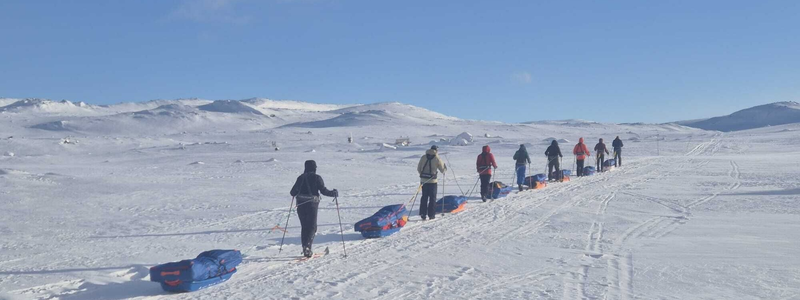
In early March, a small group of Boardwave members travelled to Finse, Norway, for the Boardwave Polar Expedition Leadership Challenge, a five-day experience co-hosted with WellFounded.
Co-Founded by Dr Jack Kreindler, WellFounded is a global, concierge team of elite physicians and scientists, dedicated to peak performance. This was Dr Jack’s eleventh polar trip, with the company designing regular leadership and experiential learning programmes that place people in demanding environments where resilience, judgement and teamwork can be tested in real time. In Finse, that meant taking a group of Boardwave’s members onto the Hardangervidda plateau, one of Europe’s most striking and unpredictable wildernesses, alongside a team of expert polar guides.
The expedition was led on behalf of Boardwave by our Breakout Moderator William Alexander, and the purpose was not adventure for its own sake. It was to create the conditions for reflection, challenge and shared experience, and to see what leadership looks like when many of the usual routines and comforts of working life are stripped away.
Without giving away any spoilers - that became clear almost immediately.
Starting with honesty
Before the group headed out into the snow, they spent time getting to know one another openly. Early conversations centred on a series of deceptively simple questions: who am I, how did I get into leadership, what do I want from this experience, and what should others understand about me?
The cohort itself was deliberately mixed: founders and board leaders, people at different stages of their careers, and members navigating very different moments in business and in life. Some had come for the adventure. Others were looking for space to think more clearly about what comes next.
Just as varied were the personalities in the room. Some described themselves as naturally reserved, serious-looking, or inclined to sit slightly outside the centre of a group until they felt comfortable. Naming those things early mattered. It removed some of the usual guesswork, replaced assumption with understanding, and made it easier for people to interpret one another generously.
As William Alexander reflected afterwards, that early openness made people “much more open with each other during the trip”, and more willing to say honestly what they were feeling.
That honesty became one of the defining characteristics of the week.
“What struck me most on this adventure,” William wrote later, “was the honesty in the group: about challenge, uncertainty, and what each of us needs.”
When the conditions force a pivot
The original plan was to spend time preparing together before beginning the three-day expedition. Instead, worsening weather forced a rapid change of approach.
A major storm was moving in, and the group had to head out early in order to make safe progress before conditions deteriorated further.
For Dr Jack, this was one of the defining moments of the experience.
“We had to go straight out,” he said afterwards. “Otherwise we wouldn’t have been able to go.”
The shift compressed the transition from arrival to action. It removed some of the comfort of preparation and made adaptation immediate. In doing so, it turned the expedition into a direct lesson in leadership.
One participant later reflected that leaders need to “be aware of changes in context that require explicit and quick adjustment to the plan”, while recognising the lesson that “vision persists despite the change in strategy to get there”.
That was one of the clearest lessons from Finse. Good leadership is not about clinging rigidly to a plan. It is about staying clear on the objective while adapting decisively to changing conditions.
Shared adversity accelerates trust
What quickly became clear was that success in this environment was shaped less by pure fitness than by judgement, attitude and the ability to work well with others under pressure.
The group had to read one another’s energy, adjust to different capabilities, and navigate a setting where weather and fatigue stripped away some of the usual professional polish. People who had only recently met found themselves carrying kit, building shelter, sleeping in close quarters, and working out how to move together through difficult conditions.
As William put it, “The night out, trying to sleep in a small tent at minus 14°C next to someone I’d only just met was a first for me. It showed the bonds that can quickly be built, especially when facing a tough environment.”
That sense of accelerated connection came through in other reflections too. One participant described the expedition as “a home run”, saying it provided “everything I was looking for: challenge, nature, people.”
There is a particular kind of candour that emerges when external conditions leave little room for performance. In Finse, the environment did much of the work. It exposed differences, sharpened interdependence and made trust less theoretical than practical.
Leadership is not one style
One of the most useful lessons from the trip was how quickly people were forced to confront differences in leadership style.
This was not a uniform group. Some members were physically stronger and keen for greater challenges. Others were newer to this kind of environment. Some were naturally spontaneous; others more measured. Over the course of the expedition, those differences became less divisive and more instructive.
Participants reflected on the need to be more patient with people whose styles differ from their own. One noted the importance of not expecting others to be “mini me’s”. Another came away with a renewed appreciation for the fact that “you can lead from the front, the middle, or behind.”
That is one of the clearest insights the expedition surfaced. Leadership is not a fixed posture. It requires range.
As one participant put it afterwards, “The leader can evolve from ‘brave warrior’ to ‘considered architect’ to ‘wise monarch’ and flex according to the situation.”
In other words, effective leadership is not simply a matter of intensity or conviction. It is also a matter of judgement: when to push, when to pause, when to direct, and when to create space for others.
Asking for help is part of the job
If there was one lesson that translated most directly back into business, it was the importance of sharing the load.
Dr Jack described this as perhaps the most striking pattern he observed across the group: “The key takeaway is that leaders who usually rely on other people, and those who usually never rely on anyone except themselves, both started to rely on other people, and enjoyed the sharing, and the taking on of load.”
That matters because many leaders are accustomed to carrying responsibility in ways that can gradually become isolating. In Finse, the environment made self-sufficiency harder to sustain as a default posture. People had to be honest about what they needed, whether that meant a slower pace, practical support or simply acknowledgment that conditions were more demanding than expected.
One participant reflected on this directly: “It’s okay to ask for help. Which is important to me in my current state of transition.”
It is a simple lesson, but not a small one. Teams function better when support is offered early, accepted without embarrassment, and understood as part of collective performance rather than individual weakness.
Clear briefings, better outcomes
Another recurring lesson was the value of clarity.
Several participants spoke about the positive impact of clear briefings, and about their intention to be more deliberate in the briefings they give back in their own organisations.
In uncertain conditions, clear communication does not remove ambiguity altogether, but it does create enough alignment for people to move with confidence and purpose.
One of the attendees, Florian Clever, reflected on this after the trip. “The best teams communicate early. The guides didn't wait for problems. They anticipated and adjusted.”
That instinct: to communicate before friction becomes failure, is as relevant in scaling a company as it is in a storm system.
A reset that sharpens perspective
For all its physical challenges, the expedition also gave people something else: distance from the usual pressures of leadership.
Dr Jack described Finse as “an instant reset”, adding simply: “The place has something otherworldly about it.”
Some participants spoke about needing a break. Others about becoming clearer on what they want next. Others still about rediscovering the joy of doing new things after years of professional routine.
One participant noted how striking it was that things which initially felt intimidating quickly became manageable with the right guidance. Another reflected on the reminder that growth often comes when you genuinely do not know what is coming next.
This is perhaps why the expedition resonated so deeply. It was not only challenging. It was clarifying.
In senior leadership, time away is often framed as recovery. What experiences like this offer is something slightly different: perspective. Removed from routine, hierarchy and the pace of day-to-day decision-making, people are often able to see themselves and one another with greater accuracy.
What leaders take back
By the time the group returned home, they had not completed the exact expedition first imagined. The weather had seen to that. Yet in some ways, that made the experience more valuable, not less.
The week became a live test of how people respond when plans change, when expectations need resetting, when teams include different strengths, and when progress depends less on control than on trust.
For those who took part, the return from Finse was not only with photographs and stories, but with sharper insight into their own leadership: greater patience, stronger awareness of context, a clearer instinct to communicate well, more willingness to ask for help, and a deeper appreciation for the different ways leadership can be expressed.
Above all, the expedition served as a reminder that uncertainty is not an interruption to leadership. It is often the moment when leadership becomes most visible.
In Finse, the horizon was not always clear. But the lessons were.
March 2026
Amy Wilson Wyles | Boardwave





_(logo).svg)













.webp)











.webp)


























.svg)




.svg)
















.webp)