

Insights
Boardwave Live 2026: Five key takeaways
The next chapter isn't about whether Europe can build. It's about how far we can go.
Almost every piece of advice about AI starts with the same word: faster. Two days in the Berkshire woods made the case for the opposite, and surfaced a tension almost every leader is wrestling with.
There is a particular kind of pressure that comes with leading a company through the AI moment. It isn't the pressure of not knowing what to do. Most of the founders and CEOs who gathered at Wasing Estate could see clearly enough what was possible. The pressure is subtler: the sense that the thing is moving faster than you can think about it, and that every week spent thinking is a week your competitors have spent acting.
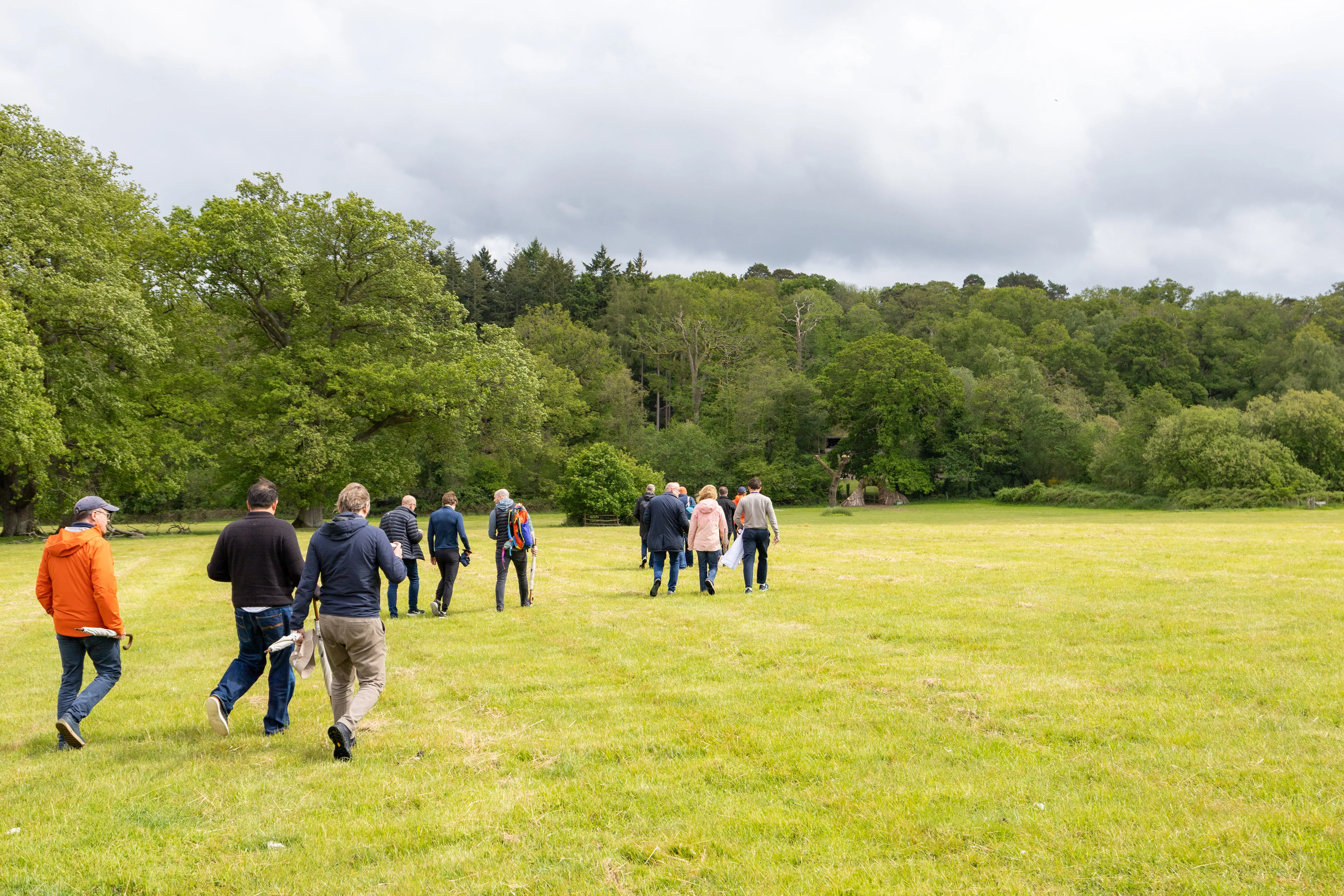
The premise of the retreat was a deliberate provocation against exactly that instinct. Slow down to speed up. Take a cohort of European leaders out of the churn, put them in ancient woodland with cold water, breathwork and very little signal, and give them two days to do the one thing the pace of AI makes almost impossible: think clearly.
What emerged was a productive argument, because it's the same argument going on inside most leadership teams right now, usually unspoken.
Rob Elkin of Rational Partners showed the room what it looks like when a business is already living the change. Rational Partners is a CTO consultancy that drops senior technologists into companies as fractional CTOs, runs technical due diligence for investors, and has trained roughly two thousand engineers to work with AI. Elkin has argued separately that the economics already favour moving; here he set the numbers aside and gave a live demonstration instead, around a practical question: how do you pull together the data and experience scattered across an organisation and turn it into action?
His answer started small and personal. The easiest door in, he suggested, is Claude Cowork. He walked through his own setup, wired to his email, calendar and every call transcript, generating a full week-in-review across twenty-eight meetings, drafting his emails in a voice a playbook had learned from a few hundred of his old ones, and running workflows he can now set going and leave to finish. He mostly talks to his computer rather than typing, and mostly no longer writes emails himself at all. What mattered was less the minutes saved on any one task and more the compounding effect once the whole way of working shifts, along with the importance of giving people the time and the permission to reach that shift themselves.
Then he talked through the organisational version. Rational Partners runs its entire business on an internal system of around 1.2 million lines of code, not one line of which was written by a human, instead it was built by Elkin and his business partner with a fleet of roughly fifty agents doing narrow, tightly guarded jobs across sales, recruitment, due diligence and finance. Curating the data to get there took real work, he was candid about that, but a build that would once have taken a team a year took the two of them a few months, and a project that used to run to eighteen months can now run in three to six. His caution was equally practical: whatever you build, you then have to maintain, so build-versus-buy is a case-by-case judgement about complexity, cost and distraction rather than a reflex. And for all the reach of those agents, he drew the same line everyone else in the room kept drawing. The agents are strong at synthesis and the heavy lifting, he said, and no substitute for taste or the human parts of the work, which is why a person still signs off on everything that matters.
Where Elkin pushed on how far the machine can go, Nathalie du Preez insisted on the human reality that governs how fast it can actually get there. You can force a structure, but you cannot force belief, and transformation that people don't believe in doesn't survive contact with a busy Tuesday.
Her playbook for "taking people with you" is unglamorous in the best way. Over-communicate the why until it stops being a memo and becomes culture. Audit not just which tools your teams use, including the personal, unofficial ones, but the appetite and anxiety sitting underneath. Make small wins visible (she's a fan of "That's a Wrap" Fridays, where teams demo what they've automated that week). Hire the people who multiply others and hold the room when things wobble.
And beneath the tactics, a claim that pushes back on the whole efficiency frame: the real constraint sits in the judgement layer. Emotional intelligence, moral courage, contextual empathy, the willingness to make a call the data alone can't justify: these are the things AI can't do, and precisely the things a poorly handled restructure can accidentally gut. As Harari, whom she quoted, puts it, the human advantage now lives in the combination of head, heart and hands.
These two instincts don't cancel each other out. They pull in opposite directions on tempo, which is exactly why they're so hard to hold at the same time. Elkin has reoriented his entire company around rebuilding with AI, and he is right that the tools already reach further than most organisations have grasped, and that comfort is the enemy of change. Du Preez is right that a structure nobody has bought into is just an org chart. Tellingly, Elkin lands in the same place she does on what stays human. The leaders who navigate this well will resist picking a side. The harder discipline is to run both at once: the ambition to rebuild, and the patient, deliberate work of bringing people with you.
If Elkin showed how far the tools reach, Rebecca Osman of Cruxy went after a more uncomfortable question about value. AI, she argued, is forcing every software business to answer a question it should have been asking all along: what value do you actually create, and what is your right to exist? For twenty years B2B software was sold by the seat, and that model is being retired quickly. AI-native competitors now deploy in four weeks what used to take a year, and at around a tenth of the cost, while the value of the software itself compresses. In a Cruxy survey of 300 B2B tech CEOs, more than 80% of enterprise SaaS firms had already fielded AI-related requests for price cuts, a figure that climbed past 90% among private-equity-backed businesses, and nearly nine in ten expected to move off seat-based pricing within two years.
Her prescription was a discipline of honesty. Map your value to the actual workflow, and separate what customers truly pay for from what has quietly become table stakes. Generic AI copilots and summarisation, she argued, are no longer things you can charge for. The core value drivers you can charge for are the harder-won ones: proprietary data, decision automation, embedded domain knowledge, ownership of the workflow itself. The trap she sees most often is the product team that falls in love with its own roadmap and wanders into territory where it will never beat SAP or Microsoft, losing sight of why customers chose it in the first place. And because what counts as differentiated keeps sliding into table stakes, the honesty has to be continuous. Moving customers to new models, she noted, is a dial you turn gradually rather than a switch you flip.
Professor Anil Seth, in a fireside conversation with Dr Jack Kreindler, took the discussion to its foundations. Seth's central move was to prise apart two ideas we habitually bundle together: intelligence and consciousness. Intelligence, he offered, is about doing things; consciousness is the having of experience, the taste of wine or the warmth of a fire. Today's systems are plainly intelligent in some ways. Whether they could ever have experiences is a separate question, and one he is sceptical about. Turing, he reminded the room, was careful to say his imitation game measured intelligence rather than consciousness. We conflate the two because in humans they arrive together, and because language has always been a reliable sign of an inner life. AI severs that link, and we go on seeing minds in machines the way we see faces in clouds.
His deeper caution was about mistaking the metaphor for the thing. We have described the brain as plumbing, as a telephone exchange, and now as a computer, yet a simulation of a brain, however detailed, remains a map rather than the territory, in the way a simulation of a storm never gets anything wet. His own view is that consciousness may be a property of being alive rather than of running the right algorithm. The warning that followed matters for anyone deploying these tools: even when we know a system isn't conscious, we cannot help feeling that it is, which leaves us open to manipulation and to quietly outsourcing our own thinking. The subtler cost, he suggested, is that in overestimating the machines we underestimate ourselves, and diminish what it means to be human.
Kreindler read out how Claude itself had answered him when asked whether a human's embodied, "visceral" knowledge changed it. The reply was strikingly honest about its own limits: it could take on the linguistic residue of embodied knowing, but it was, in its own words, absorbing a map and not the terrain, and could not tell from the inside whether that amounted to integration or to high-quality mimicry of it. Which is the same boundary du Preez had drawn around the judgement layer, and her reference to the historian Yuval Noah Harari’s head, heart and hands theory. The retreat kept arriving at it from different directions: the part of the work that is irreducibly human is the part most worth protecting.
Which brings the whole thing back to the trees. It would be easy to read the saunas and cold plunges and woodland walks as wellness garnish on a serious business agenda. In fact they were the method. You cannot think clearly about something moving fast while you're standing in its current. The rarest resource in AI leadership right now is the space to think, and the discipline to actually take it, ahead of compute or capital or even talent.
The group arrived as a set of individuals running their own races. They departed feeling understood and part of a like-minded group, which is to say, slightly less alone with the hardest decisions any of them are facing.
_(logo).svg)














.webp)









.webp)























.svg)




.svg)
















.webp)






.webp)
%20(1)%20(1).webp)