

Insights
Boardwave Live 2026: Five key takeaways
The next chapter isn't about whether Europe can build. It's about how far we can go.
.webp)
As AI changes how work gets done, the most valuable employees will be those who can own outcomes, orchestrate systems and direct expertise. Simon Hill explores why the rise of the “Full Stack Employee” demands a rethink of how companies hire, structure roles and create value.
By Simon Hill, CEO & Founder, Wazoku
A few weeks ago I was in San Francisco and Silicon Valley as part of Boardwave’s Silicon Valley Insider Week, spending time with both US and European founders and business leaders who are trying to figure out what kind of company to build when the rules keep changing mid-game. The conversations were good. One theme kept surfacing, in different forms, across almost every discussion: what do you actually ask of people when AI is doing more of the work?
It's the right question. But I think most of the answers currently in circulation stop one level too high. The debate tends to focus on what AI does to the organisation, changes to headcount, structure, efficiency. The more interesting question, and the more actionable one for founders and the people running their teams, is what it does to the individual inside it.
Here's my view: we are watching the end of specialisation as the default unit of work. And it's happening in response to a long-established constraint that is now radically changing. Specialisation was an economic response to a specific problem. When coordination was expensive and external expertise was scarce, the best answer was to divide work into narrow tasks, hire experts in each, and manage the handoffs. That structure made sense precisely because no individual could own an outcome across its entire value chain since the logistics of doing so were prohibitive.
AI can now perform many of the cognitive sub-tasks that previously required specialist labour. Global talent ecosystems, open innovation platforms, expert networks, the kind of thing Wazoku and Innocentive have spent years building and nurturing, make deep expertise accessible on demand without a permanent employment relationship. Several of the founders I spoke to in San Francisco were describing situations where a single person, well-supported by AI and the right external networks, was producing output that would previously have required a team of four, five or even many more.
What they were describing, without using the term, is what I've started calling the Full Stack Employee.
The term comes from software engineering, where a full stack developer works across the complete technical architecture of an application rather than owning a single layer. The Full Stack Employee generalises that idea to knowledge work at large. Rather than executing defined tasks within a workflow managed by others, they own an outcome and orchestrate whatever combination of capability is required to achieve it: their own judgement; AI agents handling the analytical and generative sub-tasks; and ecosystem partners providing specialist depth for the problems that require it.
The honest answer is that this requires more than updating a job description. At Wazoku, we are redesigning every role in the organisation around this model. That means defining each role by the outcomes it owns rather than the tasks it performs and then mapping the AI agents and ecosystem resources that support the person holding it. We are bringing those agent workers into our org charts, not as a theoretical exercise, but because if you cannot see where AI is operating in your organisation and what it is accountable for, you cannot manage the workflow or govern the quality of what it produces. It is a more fundamental rethink than we anticipated.
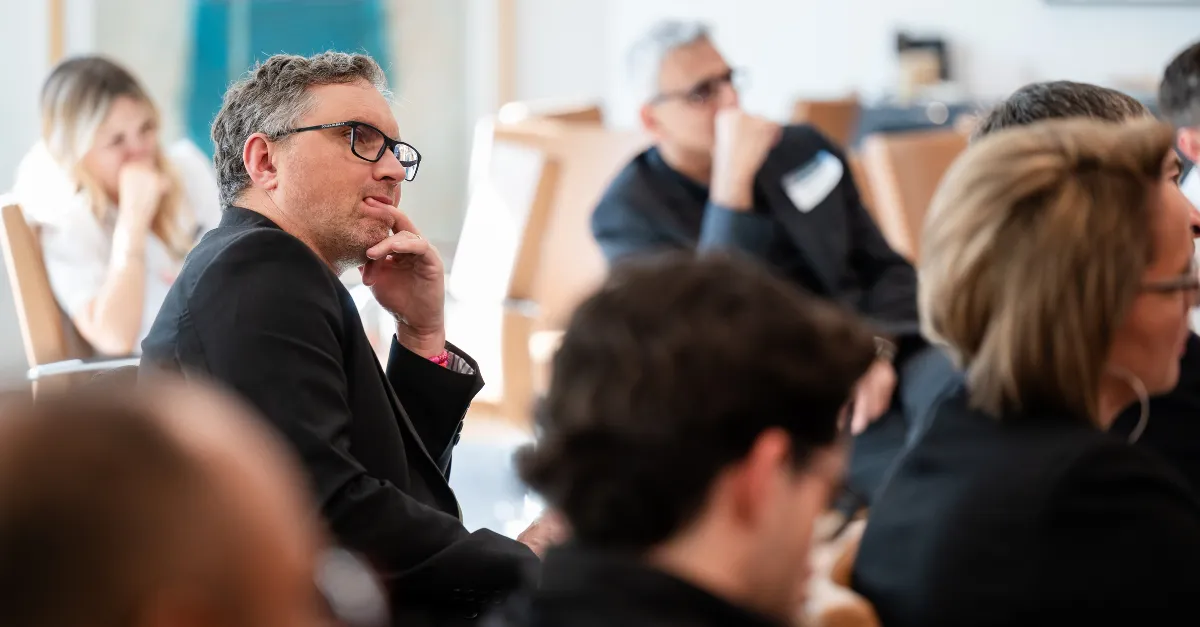
The structure of a Full Stack organisation looks genuinely different from a specialist one: fewer handoffs, broader ownership, different management cadences, different performance conversations. To be clear about something that often gets lost in this discussion, we are not reducing headcount. The point is not to replace people with agents. It is to redesign how people work so that their time and judgement are applied to the things that actually require them, with AI handling the execution that doesn't. The goal is to increase the productivity and impact of the people we have, not to have fewer of them.
Most organisations will not get there by deploying AI tools into an unchanged structure. The structure itself has to change.
The organisations producing disproportionate output right now (small teams, outsized results) are not staffed with unusually gifted people. They are structured differently. Everyone in them is, in some meaningful sense, a Full Stack Employee: accountable for outcomes rather than tasks, directing AI systems as part of their standard workflow, drawing on external expertise as needed. That's not a prediction about where things are heading but a description of what's already working.
The practical question for leaders has evolved from where to deploy AI to how to build the orchestration capability that makes AI productive. That starts with being honest about whether your current hiring, development, and role design is built for the world that's arriving, or the one that's leaving?
_(logo).svg)











.webp)








.webp)




















.svg)




.svg)












.webp)






.webp)
%20(1)%20(1).webp)